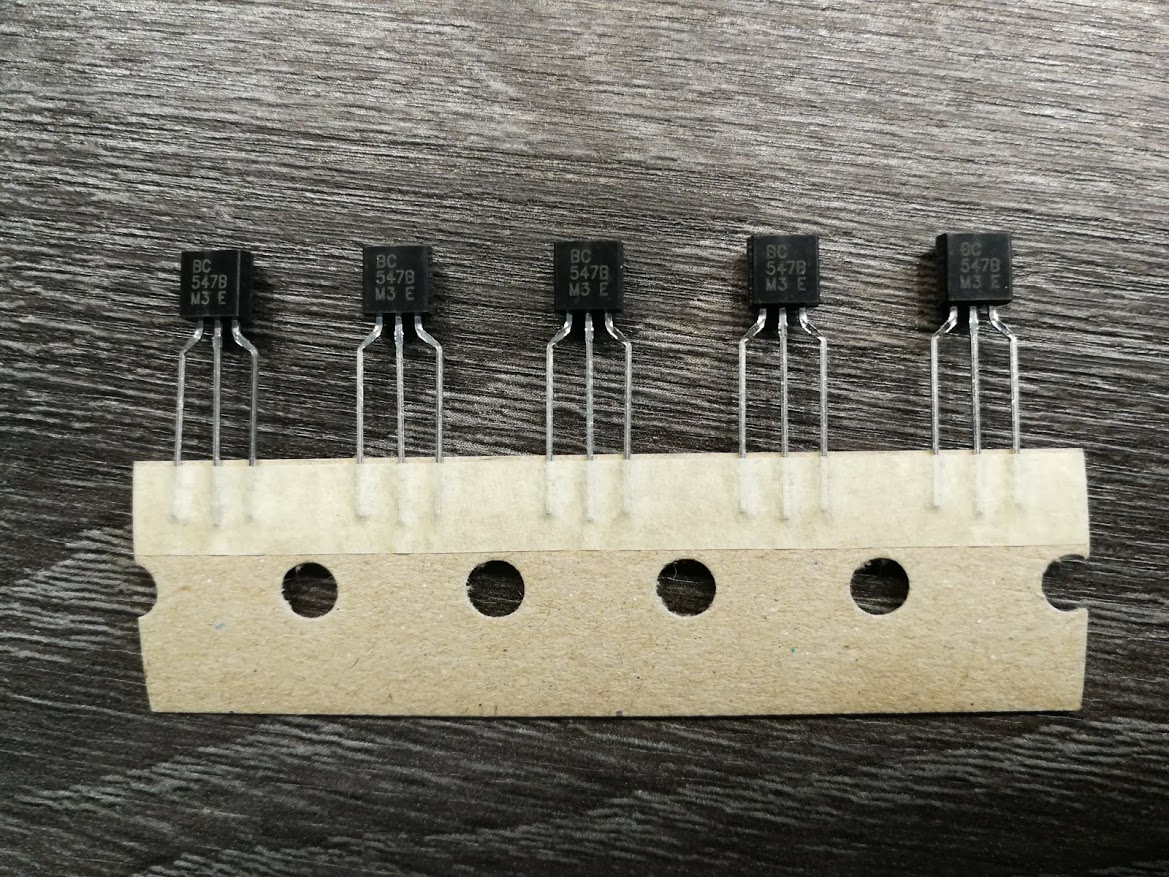
The BC557BTA is a widely used PNP bipolar junction transistor (BJT) commonly manufactured by Fairchild Semiconductor (now part of ON Semiconductor). It belongs to the BC557 family, which consists of small-signal general-purpose transistors designed for low-current, low-noise amplification and switching in analog and digital circuits. Among hobbyists, electronics engineers, and circuit designers, the BC557BTA is valued for its reliability, compact size, stable performance, and versatility across low-power applications.
This transistor plays a crucial role in both prototyping and commercial electronic devices, especially where precise signal control is required. Understanding its electrical characteristics, operating principles, and common use cases helps designers incorporate it effectively into their circuits.
General Description
The BC557BTA is a PNP transistor, meaning it allows current to flow from the emitter to the collector when a negative voltage (relative to emitter) is applied to the base. It is typically used for amplification stages, signal processing, and switching in low-voltage circuits. Like other BC557 variants, the BC557BTA is designed for general-purpose low-power tasks, making it suitable for analog audio stages, sensor circuits, and small signal drivers.
Key Electrical Ratings
| Parameter | Value | Notes |
|---|---|---|
| Transistor Type | PNP BJT | Current flows emitter → collector |
| Collector–Emitter Voltage (V<sub>CE</sub>) | -45 V | Maximum voltage between collector and emitter |
| Collector–Base Voltage (V<sub>CB</sub>) | -50 V | Maximum voltage between collector and base |
| Emitter–Base Voltage (V<sub>EB</sub>) | -5 V | Maximum voltage between emitter and base |
| Collector Current (I<sub>C</sub>) | -100 mA | Maximum continuous collector current |
| Power Dissipation (P<sub>D</sub>) | 500 mW (approx.) | Depends on package and cooling |
| DC Gain (h<sub>FE</sub>) | 200–450 (Group B) | Indicates amplification strength |
| Package Type | TO-92 | Common through-hole package |
The B in BC557B denotes the hFE gain group, ranging from approximately 200 to 450. The “TA” suffix typically indicates tape packaging for automated insertion during mass PCB assembly.
Pin Configuration (TO-92 Package)
Looking at the transistor flat side facing you:
Alternatively illustrated:
-
Base controls transistor operation.
-
Emitter is the terminal through which the majority of current flows out.
-
Collector is the current output terminal when the device is ON.
Working Principle
The BC557BTA works on the standard BJT principle:
-
When the base is pulled slightly lower (more negative) than the emitter, the transistor switches ON.
-
This allows current to flow from emitter to collector.
-
When the base is made equal or higher than emitter potential, the transistor switches OFF.
This behavior makes it useful for:
-
Amplifying analog signals (base controls larger collector current).
-
Switching loads (base input acts like ON/OFF signal).
Notable Features
-
Low Noise – Suitable for audio circuits.
-
High Gain (hFE) – Effective for small signal amplification.
-
Good Thermal Stability – Maintains behavior in varying temperatures.
-
Low Saturation Voltage – Helps in efficient switching.
-
Direct Replacement Compatibility – Interchangeable with BC556/BC558 variants in many circuits.
Applications
The BC557BTA is commonly used in:
1. Audio Amplifiers
The transistor is often found in:
-
Preamplifier input stages
-
Microphone amplifiers
-
Tone control circuits
Its low noise characteristics help preserve audio clarity.
2. Signal Processing
Useful in:
-
Analog switches
-
Active filters
-
Sensor signal conditioning
3. Digital Switching
While not intended for high-power switching, it can control:
-
Relays (with driver circuitry)
-
LEDs
-
Low-power IC modules
4. Biasing and Feedback Networks
The BC557BTA is widely used in transistor biasing networks for stabilizing operating points.
5. Educational Electronics and Prototyping
Because of low cost and reliability, it is one of the most common components used in:
-
School and college labs
-
DIY hobby kits
-
Prototype breadboard circuits
Example Circuit: LED Switching with BC557BTA
-
When the input signal goes LOW, the transistor switches ON, lighting the LED.
-
When the input signal goes HIGH, the transistor switches OFF.
This demonstrates the inverted switching behavior typical of PNP devices.
Comparison with BC547 (NPN Counterpart)
| Feature | BC557 (PNP) | BC547 (NPN) |
|---|---|---|
| Current flow direction | E → C | C → E |
| Turns ON when | Base is lower than emitter | Base is higher than emitter |
| Common usage | High-side switching | Low-side switching |
Many circuits use BC547 and BC557 as complementary transistor pairs.
Handling and Usage Considerations
-
Avoid exceeding voltage ratings to prevent junction breakdown.
-
Limit collector current below 100 mA to avoid overheating.
-
Use base resistors to prevent excessive base current.
-
Keep circuit layout clean to reduce noise pickup.
Because it is a small-signal transistor, it is not suitable for:
-
High-power switching
-
Motor control
-
High-current regulators
Conclusion
The Fairchild BC557BTA is a highly versatile and reliable PNP small-signal transistor used across a wide range of analog and digital electronic applications. Its moderate gain, low noise profile, stable operating characteristics, and compatibility with common through-hole PCB designs make it ideal for prototyping, education, and commercial low-power circuits.
Whether it is used in audio amplifiers, sensor interfaces, switching logic, or signal conditioning circuits, the BC557BTA remains a dependable component in the toolkit of electronics designers and enthusiasts. Its continued relevance demonstrates the lasting importance of simple, effective, and well-engineered discrete semiconductor components in modern electronic systems.